
 As a long time worker in the field of Free Energy physics, and the inventor of the N machine which extracts energy from the Free Energy field of Space, sooner or later I would have to face the political nature of progress. It is not simply enough to violate the established laws of physics with a new experiment.
We are facing a situation unique in the history of the world. In the past the inventor had to serve the requirements of a vital and expanding society. The telegraph, the telephone, long distance communication, the railroad and automobile covered the globe and finally satellite communications making a truly global and planetary society. With the coming of the global society the planetary Earth became a floating island in space with only resource wars on the horizon as a foreshadowing of things to come. Limitation of resources as opposed to development of uncharted territory poses a new challenge to the inventor. In the case of Free Energy, it is not a case of being able to accomplish something which had not been done before but being able to accomplish the same things which had been done before without consumption of gas, coal or oil or the pollution of natural resources by exhaust fumes or combustion by-products. Take the case of the electric car. An automobile which could exceed the presently accepted performance while not consuming or burning oil or gas - which could be switched on before a journey and off after reaching your destination.
1 Comment
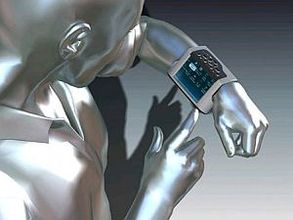 Sensor-studded clothing worn by a soldier tracks his movements and vital signs. A disposable electrocardiogram machine the size of a Band-Aid monitors a heart patient. A cellphone is implanted in a tooth. Scientists and engineers are trying to develop such “embedded” devices: miniature electronics that plug people into computer and communication networks.
Consider contact lenses that function as computer screens. A University of Washington research team, led by electrical engineering professor Babak Parviz, has developed a prototype lens fitted with a tiny radio (for receiving data) and a light-emitting diode, or LED (for displaying data to its wearer). The technology has prompted comparisons to the computer readouts that flash in the eyes of the cyborg in the Terminator films. In theory, the device converts electronic signals into ever-changing displays projected onto the contact lens and visible to the wearer, perhaps like a movie subtitle. If wirelessly connected to, say, a smartphone with voice-recognition software, a hearing-impaired person wearing such lenses might see a speaker’s words translated into captions.  Many bird species in the Amazon rainforest previously isolated and thought to be extinct in the quarter-century following deforestation have reappeared in these same areas. Lead author Philip Stouffer, an ornithologist at Louisiana State University and his co-authors measured bird populations over 25 years in 11 forest fragments of varying sizes as small as 2.5 acres in Brazil's rainforest.
In the first decade of the long-term study, birds abandoned forest fragments and, ornithologists believed, went extinct. Then in the past 20 years, many bird species returned. "Through long-term observations of fragmentation in tropical forests, this study provides verification that local extinction is accompanied by continual recolonization," said Saran Twombly, program director in NSF's Division of Environmental Biology, which funded the research. The area was fragmented in "cookie cutter chunks" as a result of policies that encouraged use of the land -- mostly for cattle -- but required landowners to leave a portion of the area uncleared. 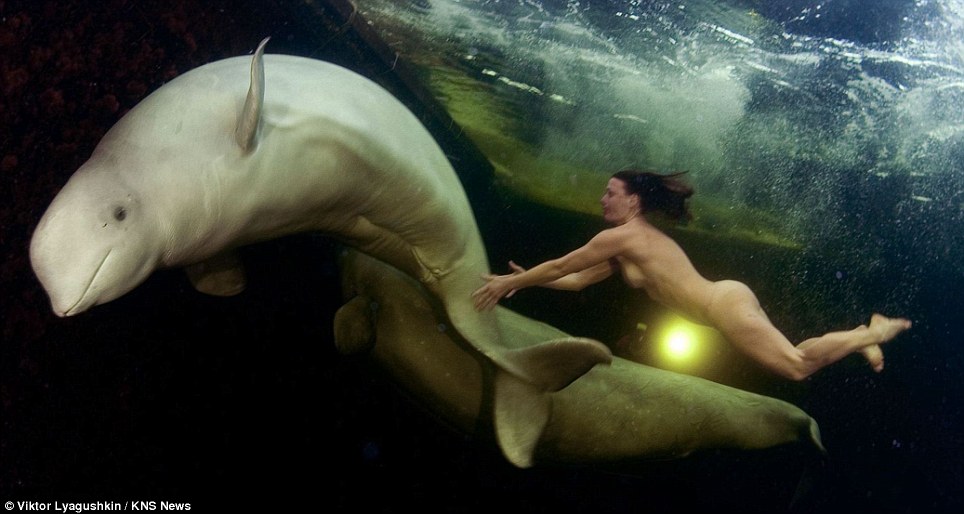 Braving sub-zero temperatures, she has thrown caution — and her clothes — to the wind to tame two beluga whales in a unique and controversial experiment.
Natalia Avseenko, 36, was persuaded to strip naked as marine experts believe belugas do not like to be touched by artificial materials such as diving suits. The skilled Russian diver took the plunge as the water temperature hit minus 1.5 degrees Centigrade. Belugas are famed for the way in which their faces are able to convey human-like expressions. Certainly Matrena and Nilma seemed to enjoy frolicking with Natalia. The taming of the whales happened in the Murmansk Oblast region in the far north-west of Russia at the shore of the White Sea near the Arctic Circle branch of the Utrish Dophinarium.  By Gregg Braden
New York Times Best-Selling Author During the last years of the Cold War, I had a front row seat as a senior systems designer in the defense industry to one of the most frightening times in the history of the world, and the thinking that led to it. During the last years of the most potentially lethal, yet undeclared, war in human history, the superpowers of the United States and the former Soviet Union did something that seems unthinkable to any rationally minded person today. They spent the time, energy, and human resources to develop and stockpile somewhere in the neighborhood of 65,000 nuclear weapons -- a combined arsenal with the power to microwave the Earth, and everything on it, many times over. The rationale for such an extreme effort stems from a way of thinking that has dominated much of the modern world for the last 300 years or so, since the beginning of the scientific era. It's based in the false assumptions of scientific thinking that suggest we're somehow separate from the Earth, separate from one another, and that the nature that gives us life is based upon relentless struggle and survival of the strongest. Fortunately, new discoveries have revealed that each of these assumptions is absolutely false. Unfortunately, however, there is a reluctance to reflect such new discoveries in mainstream media, traditional classrooms and conventional textbooks. In other words, we're still teaching our young people the false assumptions of an obsolete way of thinking based on struggle, competition, and war. |

News Watch
Mind-opening news articles, editorials, videos & apparel that inspire our readers and help liberate them from the status quo. Stay informed.
Write For Us
Reach 1000's of readers daily!


You are not a product!
Space Watch
Top NewsNews Watch Categories
All
|

|
HAVE A TIP OR STORY TO TELL? JOIN TODAY & SHARE YOUR STORY!
If you have a breaking news tip or idea, please email: tips@apparentlyapparel.com Apparently Apparel® is a registered trade name and part of the ZOAT International® brands network. © 2007-2023. All Rights Reserved. Privacy Policy. All art & news content posted on this site is commentary or opinion and is protected under Free Speech. ApparentlyApparel.com is not responsible for content written by contributing artists, authors or news feeds. The information on this site is provided for educational and entertainment purposes only. It is not intended as a substitute for professional advice of any kind. ApparentlyApparel.com assumes no responsibility for the use or misuse of this material.
|
|