Picture
The first production model of the Lockheed Martin F-35 Lightning II made its inaugural flight today in preparation for delivery to the U.S. Air Force this spring. The jet will head to Edwards Air Force Base, Calif., to support developmental testing shortly after the Air Force takes delivery.

“The aircraft was rock-solid from takeoff to landing, and successfully completed all the tests we put it through during the flight,” said Lockheed Martin Test Pilot Bill Gigliotti. “The Air Force is getting a great jet that represents a huge leap in capability, and we’re looking forward to getting it into the hands of the service pilots in just a few more weeks.”

During the flight, the conventional takeoff and landing (CTOL) F-35A variant, known as AF-6, underwent basic flight maneuvering and engine tests. Test Pilot Gigliotti took off from Naval Air Station Fort Worth Joint Reserve Base at 3:05 p.m. CST and landed at 4:05 p.m. The jet will continue flight tests in Fort Worth for about a month before it is accepted by the Air Force.


Picture
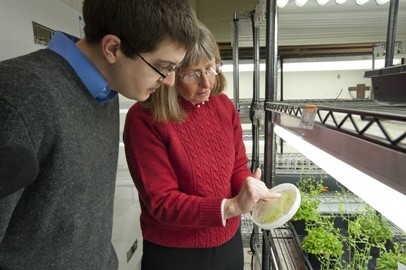
(Dr. June Medford, with some of her pollutant- and explosive-sniffing plants)
(Gizmag) There may come a day when certain plants in your workplace suddenly turn white, at which point everyone will run screaming from the building – those co-workers will have been right to do so, as the white plants indicated that a toxic gas was present. Before that scenario can take place, a little more work still needs to be done, and Colorado State University (CSU) biologist Dr. June Medford is doing it. Using a computer-designed detection trait, she is creating plants that stop producing chlorophyll when they detect pollutants or explosives in the air.

According to Medford, plants such as tobacco are as good as or better than a dog’s nose for detecting airborne substances. Unlike dogs, however, plants don’t need to be trained, housed or fed. They also don’t need to be powered or protected from the elements, unlike electronics.

With help from colleagues at Duke University and the University of Washington, Medford redesigned naturally-occurring receptor proteins using a computer program. She then modified the receptors to function in plants, and targeted them to the test plants’ cell walls.


Picture
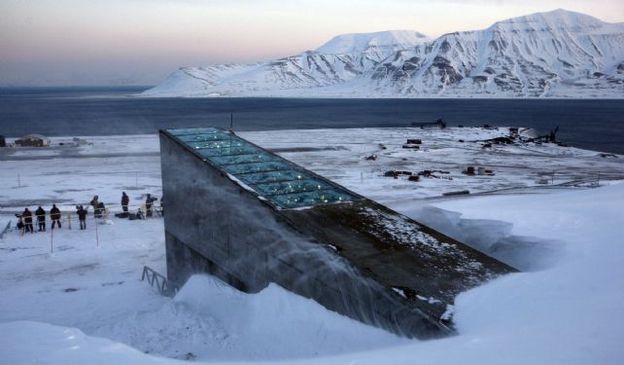
Farmers from Australia are the latest donors to a polar bear-patrolled Arctic doomsday vault that stores seeds as insurance against an international food emergency.

The Svalbard Global Seed Vault, a converted mine, is located about 800 miles from the North Pole in Arctic Norway.

An Australian delegation of farmers and scientists next week will deposit 301 samples of peas and 42 rare chickpeas in the vault, intending to protect the plant species from extinction by climatic or man-made events.

John McConnico, AP Australian farmers and scientists next week will deposit 301 samples of peas and 42 rare chickpeas in the Svalbard Global Seed Vault, shown here in 2008. "It's a very robust structure, concrete, made into the side of a mountain at Svalbard in the Spitsbergen Highlands in the Arctic," said Dr. Tony Gregson, a farmer and scientist with Plant Health Australia, an agriculture industry body.

According to the Svalbard Global Seed Vault website, the facility's main purpose is "to store duplicates ('back ups') of all seed samples from the world's crop collections. Permafrost and thick rock ensure that, even in the case of a power outage, the seed samples will remain frozen."
 
 
Picture
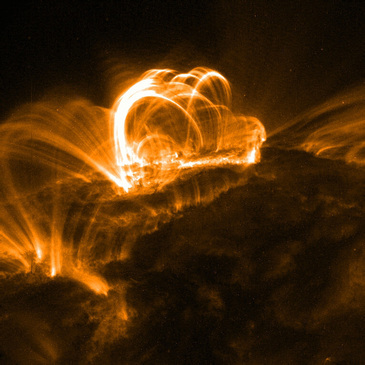
WASHINGTON (AFP) – A powerful solar eruption that has already disturbed radio communications in China could disrupt electrical power grids and satellites used on Earth in the next days, NASA said.

The massive sunspot, which astronomers say is the size of Jupiter, is the strongest solar flare in four years, NASA said Wednesday.

The Class X flash -- the largest such category -- erupted at 0156 GMT Tuesday, according to the US space agency.

"X-class flares are the most powerful of all solar events that can trigger radio blackouts and long-lasting radiation storms," disturbing telecommunications and electric grids, NASA said.

NASA's Solar Dynamics Observatory saw a large coronal mass ejection (CME) associated with the flash that is blasting toward Earth at about 560 miles per second (900 kilometers per second), it said.

The charged plasma particles were expected to reach the planet's orbit at 0300 GMT Thursday.
 
 
Picture
(PhysOrg.com) -- C60, the spherical carbon molecule also known as a buckminsterfullerene, has intrigued scientists for its unique properties and potential applications in nanotechnology and electronics. Now scientists have found that C60 may have another unusual property: it may take the form of a one-component gel under certain conditions. To date, all known gels consist of two components: an evenly distributed substance (a colloid) and a substance that dissolves the colloid (a solvent).


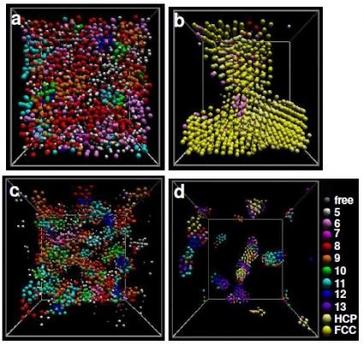
Scientists have previously discovered that C60 can take the form of different phases of matter, including solids and liquids. Here, chemists Patrick Royall from the University of Bristol and Stephen Williams from the Australian National University found that C60 can theoretically exist in a dense liquid phase containing clusters, which bind together to form a gel structure, specifically a "spinodal" gel. The gel is made entirely of carbon.

In their study, the scientists performed computer simulations showing that C60 can form a gel at moderately high temperatures and very high quench rates. The simulations showed that C60 gels form in about 10 nanoseconds and are stable at room temperature for at least 100 nanoseconds, which is the maximum time that the simulations were run. 
 
 
Picture
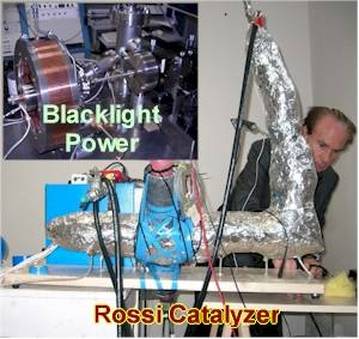
Two new revolutionary technologies are being developed that could change our planet. Are they related to each other fundamentally or do they utilize different phenomena?

Today we are facing an energy crisis that threatens the future of our species. Cheap energy from fossil fuels has allowed civilization to grow and expand. In the past hundred years the human population has went from millions to billions. As access to cheap fossil fuels becomes more difficult, all of this progress is threatened. Currently, there are at least two companies that claim to have technologies that could provide a solution to the energy crisis. One of these companies is Randall Mills' BlackLight Power (BLP) and the other is Andrea Rossi's Leonardo Corp.


BLP and Cold Fusion in a Nutshell

BlackLight Power claims to have a technology based on producing shrunken hydrogen atoms called "hydrinos." Basically, their claim is that when atomic hydrogen comes into contact with one of several catalysts (there are at least a dozen) the orbit of the electron around the hydrogen nucleus is reduced below the "ground state" and energy is released.


Picture
(AA) In today's world of high-tech portable gadgets, iPods and cell phones, we've become dependent upon readily accessible electric outlets to power our devices and charge our batteries. But now researchers at the University of Washington have discovered nature's alternative to the power outlet: living trees.

That's right, living trees. UW engineers Babak Parviz and Brian Otis have invented an electrical device that can be plugged directly into any tree for power. "As far as we know this is the first peer-reviewed paper of someone powering something entirely by sticking electrodes into a tree," said Parviz.  

The research was based upon a breakthrough study last year out of MIT, when scientists found that plants generate a voltage of up to 200 millivolts when one electrode is placed in a plant and the other in the surrounding soil. Those researchers are already designing devices which act as forest sensors powered entirely by this new method. But until now, no one has applied these findings to the development of tree power

It all began last summer with UW undergraduate student Carlton Himes (also the study's co-author). He spent his summer wandering around the woods surrounding campus, hooking nails to bigleaf maple trees and connecting them to his voltmeter. Sure enough, the trees registered a steady voltage of up to a few hundred millivolts.  

The next step for the UW team was to build a circuit to run on the available tree power. Because the voltage generated by the trees can be so small, the resulting device -- a boost converter -- was specialized to take input voltages of as little as 20 millivolts to be stored to produce greater output. The device's produced output voltage ended up being 1.1 volts, which is enough to run low-power sensors.

Of course, the researchers were quick to point out that the technology is still a long way off from being able to power normal electronics. "Normal electronics are not going to run on the types of voltages and currents that we get out of a tree," Parviz said.  

At the very least, these findings open the door for new generations of electronics which might eventually be efficient enough to take advantage of tree power. It certainly excites the imagination. Maybe in time we'll be witness to weekend picnickers lounging in local parks with their iPods and cell phones plugged into the surrounding foliage.

Photo: Engineers Babak Parviz and Brian Otis demonstrate with students how a device can be plugged into a tree for power. (Photo: University of Washington)
 
 
Picture
(ENS) - New York, NY - "Forests for People" is the theme of the UN's International Year of Forests 2011 - launched at a ceremony today at UN Headquarters in New York attended by world leaders, Nobel Peace Laureate Wangari Maathai and forest experts. While the worldwide rate of deforestation remains "alarmingly high," the UN says in its latest biennial report on the state of the world's forests, the rate of forest loss is slowing. Europe has more forests than any other region, due to the vast forests of Russia, while Latin America and the Caribbean had the highest net forest loss over the last decade.

At least 1.6 billion people depend on forests for their daily livelihoods and subsistence needs, and the world's forests are home to more than 60 million people, many of them members of indigenous communities, the UN says.

The UN General Assembly designated 2011 as the International Year of Forests, and today Secretary-General Ban Ki-moon said this year will be used as a pathway to raise awareness about the management, conservation and sustainable development of all types of forests.

"By declaring 2011 as the International Year of Forests, the United Nations General Assembly has created an important platform to educate the global community about the great value of forests - and the extreme social, economic and environmental costs of losing them," said Ban.
 
 
Picture
by Terrence Aym, Helium

"Superstorms can also cause certain societies, cultures or whole countries to collapse. Others may go to war with each other."


(CHICAGO) - NASA has been warning about it…scientific papers have been written about it…geologists have seen its traces in rock strata and ice core samples…

Now "it" is here: an unstoppable magnetic pole shift that has sped up and is causing life-threatening havoc with the world's weather.

Forget about global warming—man-made or natural—what drives planetary weather patterns is the climate and what drives the climate is the sun's magnetosphere and its electromagnetic interaction with a planet's own magnetic field.

When the field shifts, when it fluctuates, when it goes into flux and begins to become unstable anything can happen. And what normally happens is that all hell breaks loose.


Picture
(CBS) A controversial bill handing President Obama power over privately owned computer systems during a "national cyberemergency," and prohibiting any review by the court system, will return this year.

Internet companies should not be alarmed by the legislation, first introduced last summer by Sens. Joseph Lieberman (I-Conn.) and Susan Collins (R-Maine), a Senate aide said last week. Lieberman, an independent who caucuses with Democrats, is chairman of the Senate Homeland Security and Governmental Affairs Committee.

"We're not trying to mandate any requirements for the entire Internet, the entire Internet backbone," said Brandon Milhorn, Republican staff director and counsel for the committee.

Instead, Milhorn said at a conference in Washington, D.C., the point of the proposal is to assert governmental control only over those "crucial components that form our nation's critical infrastructure."

Portions of the Lieberman-Collins bill, which was not uniformly well-received when it became public in June 2010, became even more restrictive when a Senate committee approved a modified version on December 15. The full Senate did not act on the measure.


    Get Each Post by Email:

    Categories

    All
    2012
    2013
    Alternative
    Animals
    Community
    Consciousness
    Conspiracy
    Cover Ups
    Disclosure
    Diy
    Dna
    Earth Changes
    Earthquakes
    Economy
    Energy
    Environmental
    Ets
    Free Energy
    Frequency Levels
    Government
    History
    Human Interest
    Industry
    Life & Health
    Meta Tech
    Music
    Mystery
    Native American
    Nature
    Obama
    Opinion
    Paranormal
    Physics
    Planet Earth
    Preparedness
    Pyramid Power
    Science
    Space
    Spiritual
    Sustainable
    Technology
    Tesla
    The Truth
    Ufo
    Us Economy
    Us News
    World News

    Archives

    May 2013
    April 2013
    January 2013
    October 2012
    September 2012
    August 2012
    July 2012
    June 2012
    May 2012
    March 2012
    February 2012
    January 2012
    December 2011
    November 2011
    October 2011
    September 2011
    August 2011
    July 2011
    June 2011
    May 2011
    April 2011
    March 2011
    February 2011
    January 2011
    December 2010


    Community Corner
    (Links & Paid Advertisements)

    Is there a reason the Ancient Ones built pyramids and stone structures around the world, placing them exactly where they knew the earth's energy naturally occurs?
    FREE EBOOK 5/24 - 5/28

    Pyramid Power Extracts

    Picture
    Hard to find herbal extracts...

    Picture
    Become a Newsroom Contributor!

    The AlienScientist Official Website: A detailed technical briefing on super advanced technologies ranging from antigravity, invisibility, cold fusion, and more.
    AlienScientist.com

    Picture
    Click for NaturalNews.com

    Picture
    Top Contributor | BeforeItsNews

    Picture
    Kona's Only Alternative ResearchTeam

    Official Home of


    Picture
    The Hemp Industry Assoc.

    Picture
    Learn To Meditate for Free

    Picture
    Advertise or Contribute today!
    Get our toolbar!

    Picture
    PUT YOUR MESSAGE HERE!

    Latest Earthquakes
    (Up to the minute)

    Emergency Info

    Volcano News